If you're trying to figure out is Black Myth: Wukong worth it in 2026, the short version is pretty simple: yes, for most action RPG players, it absolutely is. Since launching in August 2024 on PC and PS5, Game Science’s breakout hit has moved more than 20 million copies and kept a very active community going well into 2026. Built around Journey to the West, one of the most important classics in Chinese literature, the game puts you in the role of the Destined One and sends you through six visually striking chapters with the Ruyi Jingu Bang in hand. Now that it’s available on PC, PS5, and Xbox Series X/S, the value is stronger than ever—but your final answer still depends a lot on what kind of player you are and what hardware you’re using.
Is Black Myth: Wukong Worth It in 2026
By 2026, Black Myth: Wukong is in a much better place than it was at launch. Multiple patches have cleaned up performance, improved stability, and made the overall experience easier to recommend across platforms. The Standard Edition usually sits around $59.99 USD / €59.99 EUR, while the Deluxe Edition adds the Bronze Cloud Staff weapon skin, opera-inspired armor cosmetics, decorative extras, and a soundtrack bundle. At full price, it holds up well against other premium action RPGs.
| Player Type | Verdict | Recommended Version |
|---|---|---|
| Soulslike veteran seeking boss-dense action | Buy now | Standard |
| Mythology and spectacle enthusiast | Buy now | Standard or Deluxe |
| Boss-rush and challenge-mode completionist | Buy now | Deluxe |
| Casual player seeking easy-mode accessibility | Wait for sale or skip | — |
| Low-spec PC owner (below RTX 2060 tier) | Wait or skip | — |
| Open-world sandbox explorer | Temper expectations | Standard on sale |
For most players, the Standard Edition is the better value. The Deluxe extras look nice, but they do not change combat performance or progression in any meaningful way, so you’re getting the full gameplay package either way. If you can catch the game during one of its usual sale windows—historically around 20% to 30% off—that’s honestly the sweet spot.
Xbox Series X players got access in August 2025, one year after the original PC and PS5 release. According to Game Science’s CEO, the delay came down to optimization issues on Xbox Series S rather than any kind of exclusivity deal. That matters, because by 2026 all major current platforms are covered, and the buying decision is now more about preference than availability.
Black Myth: Wukong Gameplay Value
Combat Feel and Boss Design
This is where Black Myth: Wukong really earns its reputation. The combat system is built around three staff stances—Smash, Pillar, and Thrust—and each one changes how you approach fights in a noticeable way. Smash Stance is all about heavy impact and posture damage, often breaking boss defenses in just two or three committed hits. Pillar Stance gives you more mobility and flashy kick-based follow-ups, while Thrust Stance leans into fast multi-hit pressure and efficient status application.
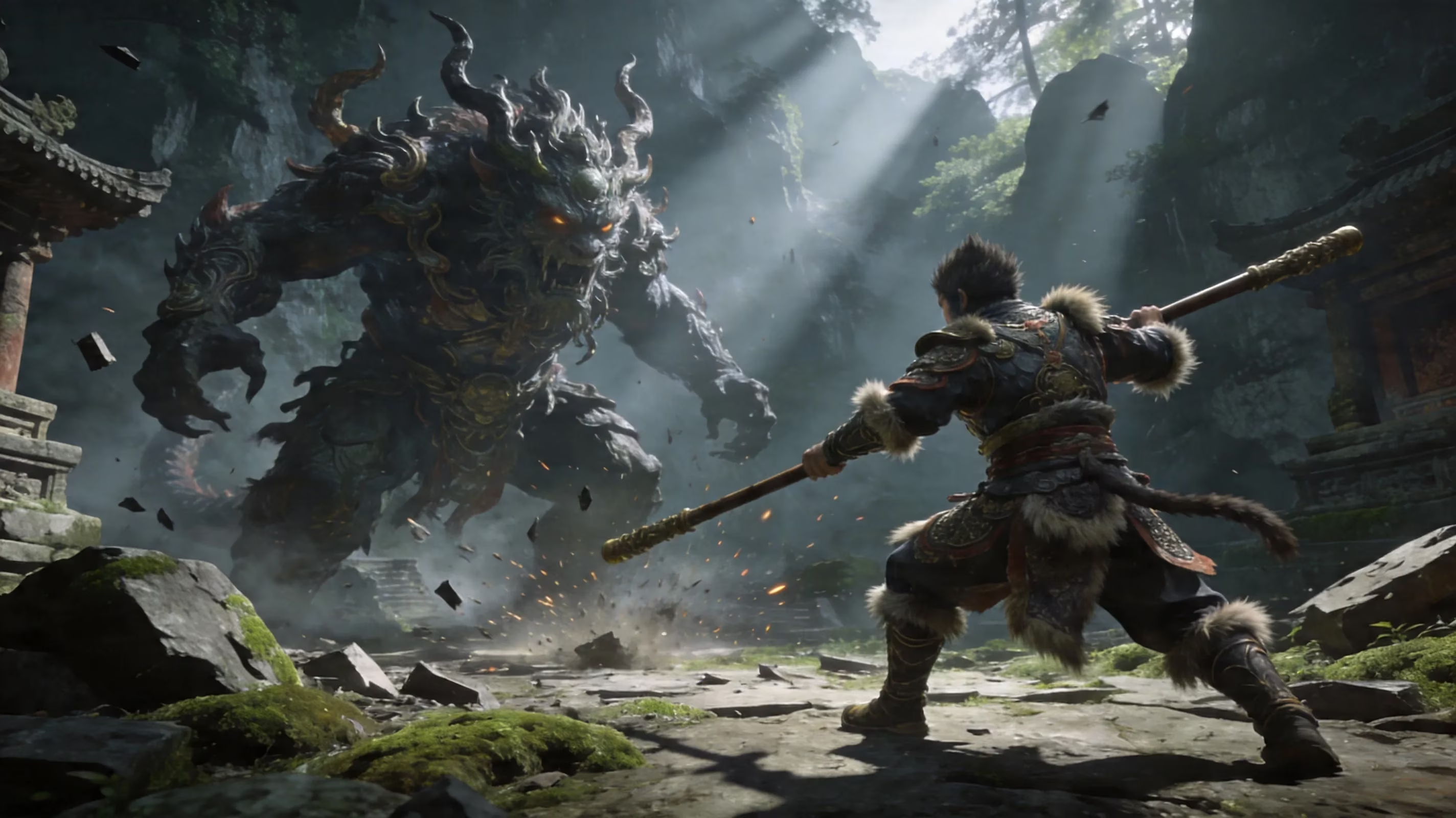
The important part is that these stances don’t feel like cosmetic variations. Swapping between them mid-combo keeps fights active and reactive, especially in boss encounters where standing still for too long usually gets you punished. It gives the combat a fluid, almost character-action rhythm instead of locking you into one rigid style.
Spells add another layer that’s way more meaningful than it first appears. Immobilize can freeze even bosses for roughly four to five seconds when fully upgraded, which creates huge damage windows if you time it well. Cloud Step drops a decoy and lets you bait out enemy strings, while A Pluck of Many summons clones to overwhelm targets. Once you start mixing stance changes, spell cooldowns, and Focus management together, the system opens up nicely.
That Focus mechanic is a big part of why fights stay satisfying over time. By staying aggressive, you build Focus and cash it in for devastating charged attacks that chunk posture and create crit opportunities. So instead of combat feeling like dodge-poke-repeat, there’s a real buildup-and-payoff loop that keeps longer encounters engaging.
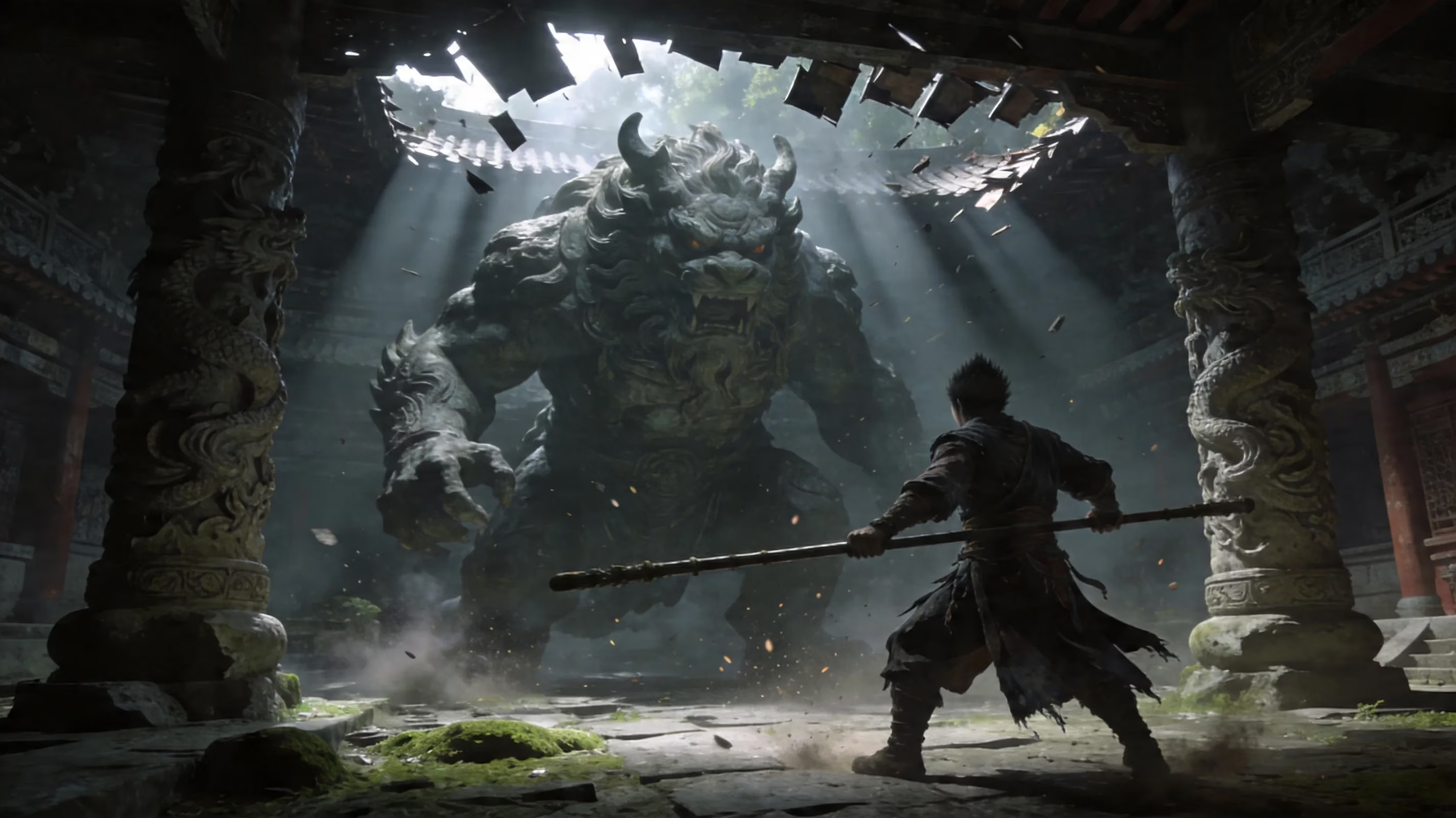
Boss design is probably the game’s strongest overall feature. Across six chapters, there are more than 80 boss fights, from smaller Yaoguai minibosses to massive multi-phase mythological set pieces. Not every single one lands at the same level—some mid-game chapters honestly peak a little earlier than their finales—but the best fights are excellent, and a few of them can stand next to top-tier soulslike bosses without feeling out of place.
The difficulty curve is demanding, but it’s fair in the way genre fans usually want. You’re expected to learn patterns, stop mashing, and respect boss mechanics. At the same time, the free respec system is a huge quality-of-life win. Since the game refunds all invested Sparks whenever you want to reallocate them, experimenting with builds never feels like a trap.
Story, World, Replay Loop
The story picks up after the events of the original Journey to the West, following a new Destined One as he uncovers what really happened behind Sun Wukong’s legend. If you already know the source material, there’s a lot here to appreciate in terms of references, reinterpretations, and mythological layering. If you don’t, the game still works because the main arc stands on its own.
Each chapter has a strong visual identity, and that helps the journey feel memorable from start to finish. You move through places like the wooded slopes of Black Wind Mountain, the volcanic chaos of the Flaming Mountains, and the eerie silk-covered spaces of Webbed Hollow. Enemy designs and encounter themes shift with each area, so the game rarely feels visually stale.
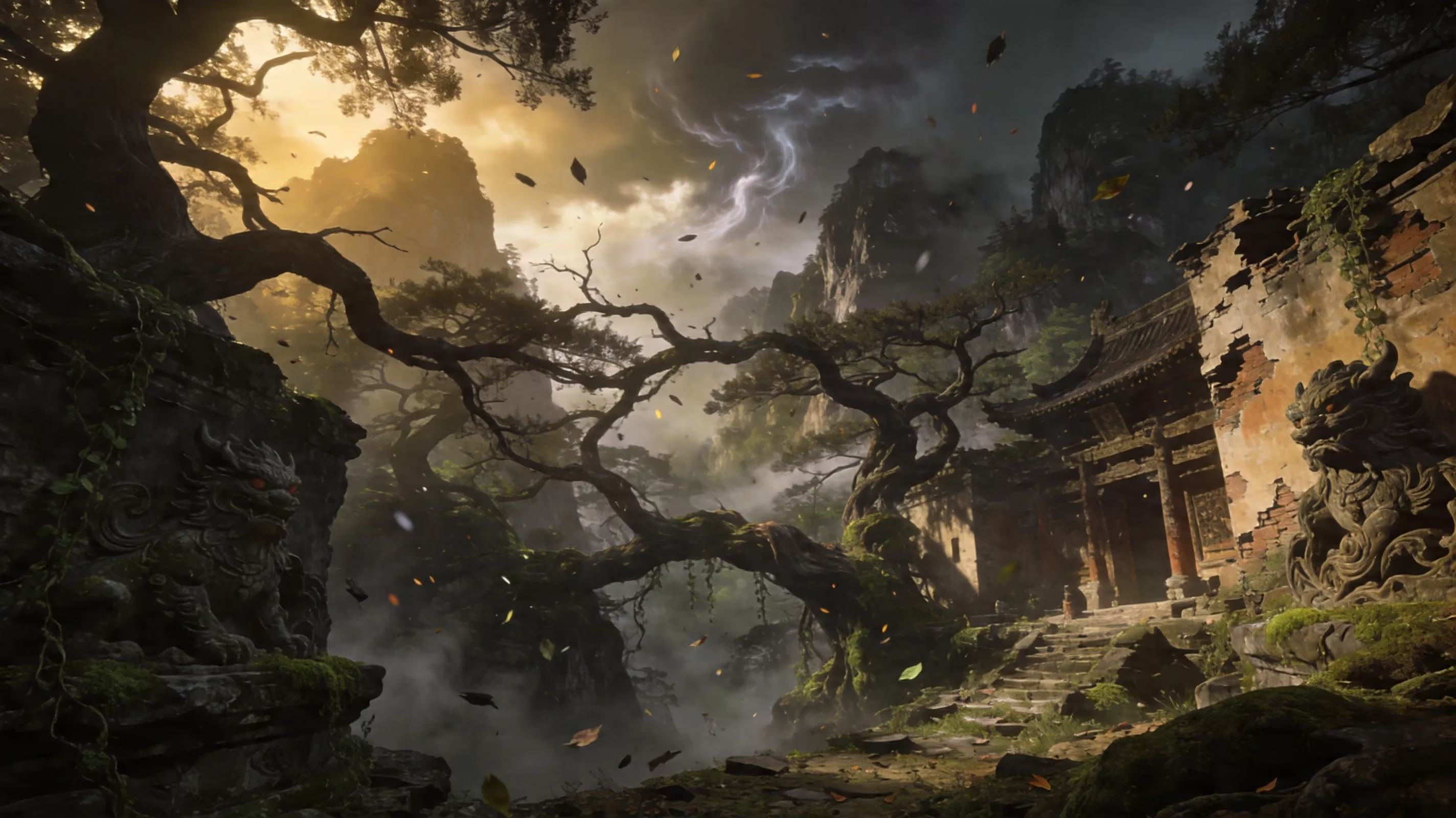
That said, it’s important to set expectations correctly. Black Myth: Wukong is not an open-world RPG. Its structure is mostly linear, with corridor-style progression broken up by side paths, hidden areas, and optional encounters. If you go in expecting Elden Ring-style map freedom, you’ll probably feel boxed in. If you go in expecting tightly designed chapters with worthwhile detours, it works much better.
Exploration still matters, though. Hidden Spirit transformations, upgrade materials, and lore-heavy collectibles are tucked into off-path spaces throughout the game, so checking side routes usually pays off. It’s not exploration for pure scale—it’s exploration with purpose.
Replay value is stronger than some players expect. New Game Plus isn’t just a stat bump; it meaningfully changes the challenge by increasing enemy aggression, adding enhanced boss phases, and revealing extra story context. The harder first phase of Erlang Shen in NG+ is one of the standout examples, and veteran players still point to it as one of the game’s most memorable fights. On top of that, Gauntlet of Legends and Return of Rivals give you structured challenge content once the main campaign is done.
Black Myth: Wukong Performance and Technical Worth
PC Performance Worth It
On PC, Black Myth: Wukong is worth buying—but only if you’re realistic about your setup. The 130 GB install size is not optional, and you really do want an SSD. The game is built around fast storage, and running it from an HDD introduces loading hitches and general roughness that drag the experience down.
The official minimum specs list a GTX 1060 6GB or RX 580 8GB alongside an Intel Core i5-8400 or Ryzen 5 1600. Technically, that gets you in the door, but you’ll be leaning on DLSS, FSR, or XeSS to keep performance playable. The recommended range moves up to an RTX 2060 or RX 5700 XT with a Core i7-9700 or Ryzen 5 5500, and even there, image scaling is basically part of the expected setup rather than an optional bonus.
On mid-range PCs, native resolution can still get rough in the busiest fights, especially in particle-heavy arenas with lots of effects going off at once. Shader stutter was one of the biggest launch complaints, particularly for some AMD users, though patching through 2025 noticeably improved the situation. It hasn’t vanished in every scenario, but it’s far less disruptive than it used to be.
If you’re running high-end hardware—think RTX 4080 class or better—the game looks incredible. This is one of those Unreal Engine 5 showcases where Lumen lighting and Nanite geometry actually make a difference moment to moment, not just in screenshots. On that kind of system, Black Myth: Wukong becomes one of the best-looking action RPGs on the market.
So, is the PC version worth it? Yes, if your hardware is at least solid mid-range and you’re okay using upscaling. If you’re below that, especially under GTX 1060 territory, it’s smarter to wait or just play on console.
PS5 and Xbox Value
On PS5, you get three graphics options: Quality mode targeting 4K at 30 fps, Balanced mode pushing up to 45 fps at 1080p, and Performance mode aiming for 60 fps with dynamic resolution scaling. For most players, Performance mode is the clear pick. After the post-launch patches, it feels stable enough on base PS5 hardware to support the fast, reactive combat the game is built around.
The DualSense support is also worth mentioning because it’s not just a throwaway feature. Staff impacts come through with satisfying haptic feedback, and charged attacks use adaptive trigger resistance in a way that adds a little extra weight to the combat. It’s not essential, but it does make the PS5 version feel especially polished.
Xbox Series X, which arrived in August 2025, is broadly on par with PS5. Equivalent graphics modes are there, and the overall presentation is very close. Series S is the compromise version, and that was the main reason the Xbox port took longer to arrive in the first place. It runs, but the reduced resolution and visual cutbacks are noticeable enough that it’s hard to call it the ideal way to play.
Loading times are short across all console versions, with shrine respawns taking only a few seconds. If you’re choosing between platforms and don’t have a strong PC, PS5 and Xbox Series X are the safest bets. Series S is serviceable, but definitely the weakest version of the bunch.
Who Black Myth: Wukong Is Worth It For
Buy Now Players
If you’ve spent time with Sekiro: Shadows Die Twice, Lies of P, or the broader FromSoftware lineup, you’re very likely the exact audience for this game. Soulslike veterans will immediately understand the rhythm: learn patterns, avoid greedy mistakes, and improve through repetition. Wukong doesn’t use stamina management the same way, and its combat is faster and more expressive, but the core challenge philosophy will feel familiar.
It’s also a fantastic fit for boss-rush players. The sheer number of encounters is impressive, and more importantly, the variety holds up. Optional bosses hidden off the main path often reward you with Spirit transformations, so exploration feeds directly back into combat progression. If you’re the kind of player who lives for “one more attempt” energy, this game has a lot to offer.
Then there’s the mythology angle. Players who enjoy Chinese folklore, classical literature, or just big-budget fantasy spectacle are getting something pretty special here. Black Myth: Wukong doesn’t treat its source material like a loose aesthetic backdrop—it leans into it with real confidence, and that gives the whole experience a distinct identity.
Wait or Skip Players
If you need accessibility-focused difficulty options, this probably isn’t your game. There’s no easy mode, no difficulty slider, and no alternate tuning for players who just want the story. The challenge is fixed, and the game expects you to meet it on its terms. If Sekiro lost you for that exact reason, there’s a good chance Wukong will do the same.
Low-spec PC owners should also be careful. Anything below the GTX 1060 tier is going to struggle enough that the experience stops reflecting the game at its best. In that case, waiting for a hardware upgrade—or buying on console instead—makes a lot more sense than forcing it on underpowered hardware.
And if what you really want is a giant sandbox with freeform exploration, you should temper expectations now. This is not Breath of the Wild, and it’s not Elden Ring. It’s a chapter-based action RPG with focused progression and hidden side routes, not a sprawling open-world adventure.
Black Myth: Wukong vs Similar Games
The most obvious comparison is Sekiro: Shadows Die Twice, and for good reason. Both games are heavily boss-focused, both center on a single primary weapon, and both draw from mythic storytelling. The difference is in how they express combat. Sekiro is built around parry timing and posture control as the main language of play, while Wukong gives you more room through stances, spells, and transformations. If Sekiro felt too rigid for your taste, Wukong may click better.
| Game | Similarity to Wukong | Key Difference |
|---|---|---|
| Sekiro: Shadows Die Twice | High — boss focus, single weapon, mythology | Parry-centric vs. spell/stance system |
| God of War (2018/Ragnarök) | Moderate — spectacle, mythology, melee combat | More narrative guidance, less punishing |
| Lies of P | High — soulslike structure, boss density | Steampunk aesthetic, no transformation system |
| Elden Ring | Moderate — challenging bosses, exploration | Open-world scope vs. linear chapters |
Compared with God of War (2018/Ragnarök), Wukong is less guided and a lot less forgiving. God of War does a better job easing players through its story and world, while Wukong asks more from you mechanically. In return, it gives you a higher skill ceiling and more freedom in how you approach combat.
Lies of P is probably the closest match in overall genre space. Both are strong non-FromSoftware soulslikes with excellent boss lineups. Still, Wukong stands apart because of its transformation system and the sheer scale of its mythological presentation. Lies of P is tighter and more gothic; Wukong is more theatrical and visually grand.
As for Elden Ring, the overlap is more superficial than it seems. Yes, both have hard bosses and exploration elements, but they’re built for very different experiences. Elden Ring is a huge open-world RPG where discovery comes from scale and freedom. Wukong is much more focused, more linear, and more concentrated around curated encounters.
What Wukong arguably does better than all of them is present Chinese mythology with this level of cinematic confidence and visual detail. There really isn’t a direct equivalent in the action RPG space right now.
Black Myth: Wukong FAQ
How hard is it?
It’s roughly in Sekiro territory and clearly tougher than the standard God of War experience on default difficulty. You’ll need to learn boss patterns, adapt over multiple attempts, and accept that there’s no difficulty slider. Most players hit several story bosses that take repeated tries.
How long to beat?
For the main story, expect around 25 to 35 hours depending on your skill level and how much side content you chase. Full completion, including optional bosses, hidden areas, and collectible Spirits, usually pushes that to 40 to 50 hours. If you get into New Game Plus and challenge modes, going past 60 hours is pretty normal.
Is Deluxe worth it?
Only if you care about cosmetics or want to support the developer a bit more. The Bronze Cloud Staff skin, opera-themed armor set, and decorative extras look distinct, but they don’t give you gameplay advantages. If you only care about combat and progression, Standard is enough.
Best platform to buy?
A high-end PC gives you the best visuals, no question. PS5 is the easiest console recommendation thanks to stable Performance mode and strong DualSense support. Xbox Series X is very close to PS5 in quality, while Series S is the least impressive version. On PC, Steam is the safest storefront pick for consistent patch delivery.
Conclusion
For soulslike veterans, boss-rush fans, and anyone who wants a mythology-heavy action RPG with serious production value, the answer to is black myth wukong worth it is a very clear yes. The combat has real depth, the boss roster is stacked, and the game’s take on Chinese mythology feels both stylish and respectful. Add in free respecs, solid NG+ support, and meaningful challenge modes, and there’s a lot here that lasts beyond a single playthrough.
The players who should think twice are just as easy to identify. If you need easier difficulty options, if your PC is below the game’s minimum comfort zone, or if you’re expecting a huge open-world sandbox, this probably isn’t the right fit. Black Myth: Wukong is demanding, storage-hungry, and pretty uncompromising about what it wants to be.
In 2026, though, with patches smoothing out the rougher edges, all major platforms now supported, and renewed attention on the franchise thanks to the announced sequel Black Myth: Zhong Kui, this is honestly one of the best times to jump in. For the right player, it remains one of the most distinctive action RPGs of the last few years—and an easy recommendation for any serious genre fan.