Black Myth: Wukong didn’t just crash onto Steam—it somersaulted through the clouds and landed with a crater-sized impression, pulling in astronomical player counts and earning an Overwhelmingly Positive review status that still glows brightly in 2026. Game Science’s action epic remains a visual feast, a boss-rush masochist’s playground, and a cultural touchstone. Yet even celestial monkeys can stub their toes, and for many players, the most baffling design omission was the complete absence of an in-game map. Navigating the lush, often identical-looking forests and mountains felt less like a pilgrimage and more like solving a jigsaw puzzle while blindfolded and spun around three times.
Enter the modding community, which descended on the game’s files like a swarm of curious, code-savvy locusts the moment it launched. Among the flurry of cosmetic swaps and goofy texture packs, one creation ascended to near-mythic status itself: the aptly named Simple Map. The mod doesn’t try to rewrite destiny; it simply pins a full-screen cartographic lifeline onto your HUD. Players could, for the first time, zoom, pan, change camera angles, and even tap a key to reveal nearby resources—transforming what was once a gorgeous but disorienting corridor crawl into a legible journey. By 2026, the mod has evolved far beyond its humble beginnings, now boasting integrated quest markers for those maddening NPCs who wander off like cats with an agenda, and crowd-sourced annotations for hidden bosses. It’s no wonder the download counter rocketed past six figures long ago.
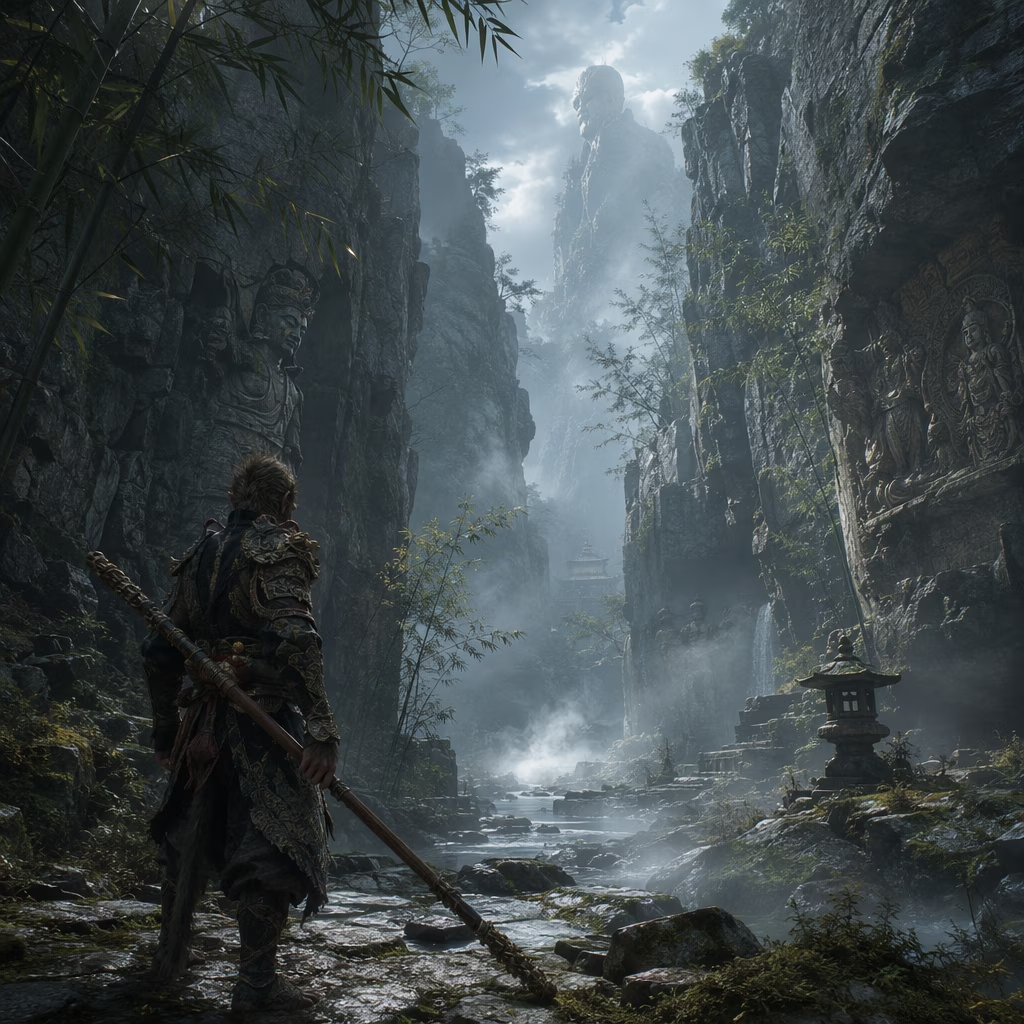
The debate over whether Wukong needed a map burned brightly back in 2024, and players still argue about it today with the intensity of tea-house philosophers. To frame the discussion, the mod acts as a kind of architectural interpreter—like someone finally turning on the lights in a baroque ballroom where everyone has been stumbling over ottomans. The game’s environments, while stunning, are often as spatially repetitive as a hall of mirrors, leaving even experienced explorers retracing their steps through the same bamboo grove for the fifth time, convinced a new path must exist.
Wes Fenlon, a seasoned critic and admitted completionist, once explained that without a map, he constantly worried about missing significant side routes. Even in the opening stage, a player in a hurry can easily sprint past one of the earliest major power-ups and bosses—a design choice that can feel less like rewarding exploration and more like punishing speed. Wes noted that the landscape, though beautiful, offered little incentive for multiple passes because interactive elements were sparse. For him, the map wasn’t a cheat; it was a memory prosthetic, a way to anchor the fleeting glimpses of a missed path. It solved the problem of orientation grief, much like a lighthouse beam finally penetrating a foggy bay.
On the other side of the monkey staff, Tyler Colp offered a more measured take that still resonates with purists. He argued that a map would truly shine only if it tracked the serpentine movements of quest-giving NPCs, a feature that eventually did worm its way into the Simple Map mod. The core level design, he contended, rarely forks into labyrinthine tangles like those found in Elden Ring’s catacombs. Most paths are rivers, not deltas, making it hard to get irrevocably lost. For players who simply wanted to know which direction the next cinematic duel lay, the map was a gentle nudge rather than a game-changer. Tyler’s perspective suggested the missing map was a deliberate friction, a way to make you live in the world rather than stare at a minimap compass. It’s a valid point, but one that crumbles a bit when you’ve spent 45 minutes circling the same stone lantern, your sanity fraying like old silk.
The magic of Simple Map lies in its flexibility, making it the modding equivalent of a Swiss Army knife for the spatially challenged. It’s not just about preventing the frustrated Alt+F4 from a player lost in a seemingly endless ravine. It’s about respecting time—the most precious resource anyone has—while preserving the game’s artistic soul. Modern updates even let you toggle the map off during boss fights, ensuring the cinematic dances with dragons and dog demons remain uncluttered. You can taste the discovery, then use the map to mop up the crumbs.
Seeing mods like this thrive years after launch tells a heartwarming story about PC gaming’s ecosystem. A single, ingenious bolt-on can smooth over a designer’s oversight, turning a 95-hour experience from an anxious cartography exercise into a focused mythic odyssey. It turns out, even a stone monkey born from heaven appreciates a little help finding the nearest shrine.