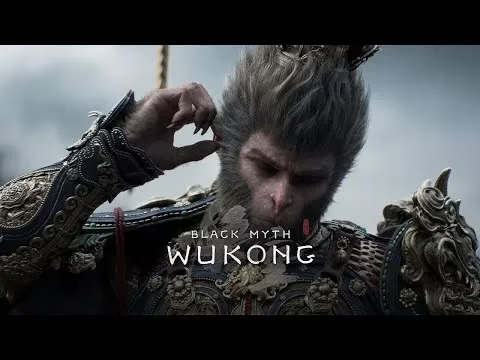
I’ll never forget the night of The Game Awards in December 2024. I was curled up on my couch, half-watching the stream, but my mind was stuck on one question: would Black Myth: Wukong actually take home Game of the Year? It felt like the game had done everything right, but the award went to Astro Bot. Even now, in 2026, I still think about the strange mix of pride and frustration that followed.
 ---LIVE-TODAY!-2p-PT_5p-ET_10p-BST_11p-CEST-42-46-screenshot-(1).png?width=570&quality=85&format=jpg&dpr=3&auto=webp>)
The result was not a total loss. Black Myth: Wukong did win Best Action Game and Players’ Voice, which meant the team didn’t go home empty-handed. But Game Science CEO Feng Ji posted a long Weibo statement that made me pause. He wrote that all the nominated games were exceptional, but he still couldn’t figure out the criteria for Game of the Year. “I feel like I came all the way here for nothing!” he said. That line hit me because it sounded less like complaining and more like genuine confusion.
What does Game of the Year even mean? Is it the most polished experience? The most innovative one? The one with the biggest cultural footprint? I still can’t answer that.
Feng Ji also admitted he wrote his Game of the Year acceptance speech two years earlier, only to never get the chance to deliver it. Imagine carrying a speech in your head for two years. Wouldn’t that sting?
He didn’t stop there. He said he had seen a lot of strong dissatisfaction in player comments, often expressed humorously or ironically, and it made him laugh. “I completely understand these feelings and share the frustration, because behind these emotions lies not pain or malice, but dignity and confidence,” he added. Some people read the statement as salty, but I saw it differently. Can you blame a creator for defending their work after watching their team pour years into something?
The emotional weight became even clearer when former Sony Santa Monica writer Alanah Pearce shared what she witnessed. During the show, she saw someone from the Game Science team crying in the audience when the game didn’t win. She said, “It clearly meant a lot to them, they did an amazing thing, but I did find that surprising.” To me, that wasn’t just about an award. It was about recognition.
Here is how the major awards shook out that night:
| Award | Winner |
|---|---|
| Game of the Year | Astro Bot |
| Best Game Direction | Astro Bot |
| Best Action/Adventure Game | Astro Bot |
| Best Family Game | Astro Bot |
| Best Action Game | Black Myth: Wukong |
| Players’ Voice | Black Myth: Wukong |
Astro Bot also had a big night, and so did Balatro and Metaphor: ReFantazio, each taking home multiple awards. But the conversation around Black Myth: Wukong felt heavier because the game had become a symbol for a new wave of Chinese development. Feng Ji was open about his hope that its success would be the beginning of more high-quality, engaging games from Chinese studios.
That hope was not just words. Just a week before the awards, the game received an update that finally added a much-requested map and a boss rush challenge mode. The timing wasn’t enough to change the outcome, but it showed the team was still listening to players. At the time, the Xbox release was still unknown, which left a whole platform of players waiting.
Looking back from 2026, I don’t think the loss erased what the game accomplished. The Players’ Voice win proved that players, at least, had spoken. But the Game of the Year snub? It still feels like one of those moments where the industry’s taste and the audience’s passion didn’t fully align. And maybe that’s okay. Maybe losing can be a louder statement than winning.
As detailed in Entertainment Software Association (ESA), industry awards often reflect a blend of critical standards and broader market context rather than pure player sentiment, which helps explain why a fan-favorite like Black Myth: Wukong could dominate Players’ Voice yet miss Game of the Year. Reading the night through that lens, the “snub” becomes less a verdict on quality and more a snapshot of how juried criteria, platform reach, and shifting industry priorities can diverge from community passion—even when a studio’s cultural moment feels undeniable.